

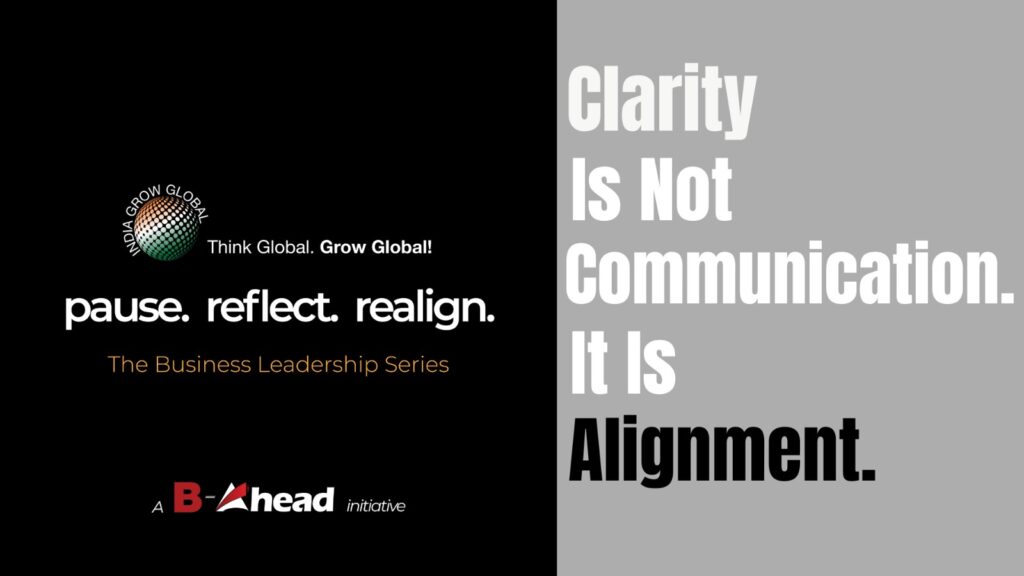
Most organisations believe clarity is something they need to improve.
What they often miss is that clarity is not a missing asset—it is a missing discipline.
Clarity does not come from more communication.
It comes from alignment.
And when alignment is weak, growth becomes fragile.
The Illusion of Being Clear
Many businesses mistake articulation for clarity.
They have vision statements.
Purpose decks.
Brand manuals.
And yet, when you listen closely, something feels off.
Ask five people in the organisation to describe what the company stands for, and you will hear five variations. Each explanation sounds reasonable. Some are even compelling.
But together, they reveal the problem.
When meaning varies by function, hierarchy, or individual, clarity does not exist.
Growth built on inconsistent meaning eventually collapses under its own weight.
Why Misalignment Slows Everything Down
Misalignment is rarely dramatic.
It shows up quietly.
Decisions take longer.
Teams hesitate.
Approvals multiply.
Not because people are incapable, but because they are unsure.
When clarity is weak, people wait to be told what is right.
When clarity is strong, people know.
This is why many growing organisations become increasingly dependent on founders and senior leaders. Not because the leaders are indispensable—but because the organisation has not internalised a shared point of view.
The founder becomes the default filter for meaning.
That may work at a certain stage.
It does not scale.
Clarity Is What Makes Organisations Independent
Strong brands are not built on personalities.
They are built on shared belief.
Purpose anchors intent.
Vision provides direction.
Values guide behaviour.
When these are clear, decisions decentralise naturally.
People across the organisation make aligned choices—not because they were instructed to, but because they understand what the organisation stands for.
This is how brands maintain consistency even as they grow.
When clarity is embedded, the organisation does not pause when leadership is absent. It continues to move with coherence.
That is not control.
That is maturity.
Why Global Brands Feel Effortless
Global brands are often described as confident or assured.
What they really are is clear.
They do not constantly explain who they are.
They demonstrate it through behaviour—again and again.
Clarity reduces friction:
- Customers know what we expect
- Partners know how to engage
- Employees know how to decide
This consistency builds trust over time.
And trust, once established, compounds.
Communication Is the Outcome, Not the Source
Many organisations try to fix clarity issues by communicating more.
More town halls.
More messaging.
More documents.
But communication without alignment amplifies confusion.
Clarity is not achieved by saying the same thing louder.
It is achieved when everyone believes the same thing deeply enough to act on it.
When clarity is real, communication becomes simple.
A Quiet Test of Brand Readiness
There is a simple reflection worth considering:
If the founder steps away for a quarter,
does the organisation move forward—or slow down?
If momentum drops, the issue is not leadership.
It is clarity.
Because clarity is what allows organisations to grow without friction, without dependency, and without dilution.
Closing Thought
Growth does not break because markets are complex.
It breaks because meaning becomes fragmented.
Clarity is what holds organisations together as they scale.
Not through control.
Not through charisma.
But through shared conviction.
And when conviction is shared, growth becomes not only possible—but sustainable.
